Oil painting is one of the oldest and most versatile techniques in art. It’s most characterized by its vibrant colors, smooth edges and unique depth. Due to its long drying time, you get the chance to work layer by layer, define details and do over whole parts of your painting. Because of this flexibility, oil paint as a medium is interesting for beginners as well as professionals.
In this article you’ll learn useful information about oil painting and what you need to get started on your own oil painting journey.
History of Oil Painting
Ever since the 13th century – the High Middle Ages – people have been using oil to paint. But only thanks to the Flemish artist Jan Van Eyck, oil painting finally had its true breakthrough in the 15th century.
Even though the artists of the Renaissance didn’t want to give up their entrusted Tempera Paint at first, the use of oil paint quickly became popular and now it’s an integral part of art.

Madonna of Chancellor Rolin, Jan van Eyck, c. 1435, Oil on panel, 66 cm × 62 cm, Musée du Louvre, Paris
What Materials do You Need?
These are the materials you need to start your oil paint journey:
- A Canvas / oil painting paper
- Oil paint (primary colors, black, white)
- Different brushes
- A palette (preferably glass)
- A Solvent, e.g. turpentine or Odorless Turpentine Substitute (OMS)
- Oil, e.g. linen- or stand oil (quicker drying time), or walnut-, poppy- or safflower oil (longer drying time)
For priming/sealing:
- Acrylic binder or Gesso, sanding paper, acrylic paint, varnish
Be Careful:
When you’re working with oil paint and solvents, make sure to paint outside or to properly ventilate the room you’re working in. Solvents – in particular turpentine – emit toxic fumes which are not only harmful for you, but also for the environment. That’s why you have to properly dispose of everything and use as little solvent as possible.
What is Oil Paint Made of?
Oil paint primarily consists of color pigments and a binder – most often linen oil – which holds everything together and gives it its typical texture.
If you want to know more about the process of making oil paint, you can read our article on this topic.
How Does Oil Paint Get Into a Tube?
What Colors do I need to Buy?
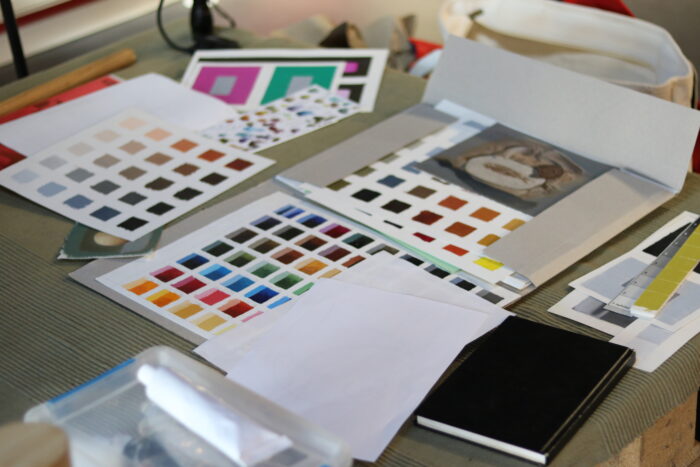
You don’t need a huge number of different colors to start oil painting. A handful of paints (blue, red, yellow, white, black) is already enough for you to be able to mix a wide range of colors.
Later you can look into broadening your color spectrum by adding shades like sienna, umber or ocher to your repertoire. These are especially great for achieving realistic skin tones and nature scenes. Moreover, these earth tones are great for underpainting or “Imprimatura” because they help make the colors harmonize with each other.
How to Prime Your Canvas for Oil Painting
It’s fundamental to use a primer when painting on canvas to keep the paint from getting absorbed. In order to get a flat and smooth finish, you sometimes have to do it several times. While most people use Gesso to prime their canvases, there are also other kinds of primers available, like acrylic-, chalk or plaster based primer.
Here you can find more information about how to prime your canvas for oil painting.
Priming Correctly When Working With Oil Paints
‘Fat over Lean’ – the Golden Rule in Oil Painting
The most important rule in oil painting is working ‘fat over lean’. Because oil paint dries through the absorption of oxygen, you have to make sure every new layer dries quicker than the prior one to prevent the paint from cracking.
This is achieved by adding solvent to your oil paint and gradually lessening the amount in the following layers until you’re painting with pure oil paint. If you want to add more layers, you then have to add an increasing amount of oil to them.
If you’re interested in the different brush techniques in oil painting, you can read up on it here.
Brush Techniques in Oil Painting
How do I Varnish My Paintings?
After a drying period of around six months, you can varnish your painting to protect it from dust, dirt, UV radiation and moisture.
Depending on the finish you want, you can choose either a matte or shiny varnish. Not only will your painting last for a longer period of time but sealing it will also enhance the color brilliance and give it a unique depth.